Search This Blog

Tuesday, March 13, 2012

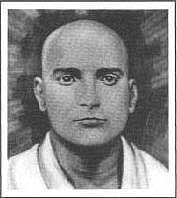
Swami Rama Tirtha (1873-1906)

ramatirtha.jpg (11232 bytes)
Swami Rama Tirtha, previously known as Gossain Tirtha Rama, was born in 1873, at Murariwala, a village in the district of Gujranwala, Punjab, India. His mother passed away when he was but a few days old and he was brought up by his elder brother, Gossain Gurudas.
As a child, Rama was very fond of listening to recitations from the holy scriptures and attending Kathas. He often put questions to holy men and even offered explanations. He was very intelligent and loved solitude.
Rama was barely ten years old when his father got him married. His father left him under the care of his friend, Bhakta Dhana Rama, a man of great purity and simplicity of life. Rama regarded him as his Guru, and offered to him his body and soul in deep devotion. His surrender to his Guru was so complete that he never did anything without first consulting him. He wrote numerous loving letters to him.
Rama was a brilliant student, especially in mathematics. After completing his degree, he served for a while as Professor of Mathematics in the Forman Christian College. It was at this stage that his spiritual life began to blossom. He began to read the Gita and became a great devotee of Lord Krishna. His intense longing gave him a vision of Sri Krishna. He used to deliver lectures on Bhakti under the auspices of the Sanatana Dharma Sabha of Lahore.
Rama Tirtha commenced his spiritual life as a Bhakta of God and then turned to Vedanta, studying under the inspiration of Sri Madhava Tirtha of the Dwaraka Math.
A great impetus was given to his spiritual life by Swami Vivekananda, whom he saw for the first time at Lahore. The sight of the great Swami as a Sannyasin kindled in him the longing to don the ochre robe.
His passion for the vision of the all-pervading Lord began to grow more and more. He longed and pined for oneness with God. Indifferent to food and clothes, he was always filled with ecstatic joy. Tears would often flow in a limpid stream down his cheeks. It was not long before he had the vision he yearned for, and thereafter he lived, moved and had his being in God.
Swami Rama was a living Vedantin. He saw and felt God in all names and forms. His beautiful words are often addressed to the trees, rivers and mountains.
Rama soon resigned his post and left for the forest. His wife and two children and a few others accompanied him to the Himalayas. Owing to ill-health, his wife later returned with one of her sons. The other was left at Tehri for his schooling there.
Rama Tirtha took Sannyas a few days before the passing of Swami Vivekananda. Swami Madhava Tirtha had already allowed him to take Sannyas whenever he wished.
A few years later he returned to the plains to preach. The effect of his presence was marvellous. His infectious joy and his bird-like warbling of Om enchanted everyone.
Swami Rama's burning desire to spread the message of Vedanta made him leave the shores of India for Japan. He went with his disciple Swami Narayana. After a successful visit to Tokyo, he departed for the U.S.A. He spent about a year and a half in San Francisco under the hospitality of Dr Albert Hiller. He gained a large following and started many societies, one of them being the Hermetic Brotherhood, dedicated to the study of Vedanta. His charming personality had a great impact on the Americans. Devout Americans even looked upon him as the living Christ
On his return to India, Swami Rama continued to lecture in the plains, but his health began to break down. He went back to the Himalayas and settled at Vasishtha Ashram. He gave up his body in the Ganges on 17 October, 1906, when he was only thirty-three.
The Rama Tirtha Publication League has brought out most of the writings of this great saint of India. They are given in several volumes, entitled, In the Woods of God-realisation. His inspiring writings show us that he saw his Beloved Lord in all names and forms. In many of his poems he sings the glory of nature.
********************
Swami Rama Tirtha's biography above has been reproduced from Swami Sivananda's "Yoga Lessons for Children (Vol. 7)", published by the Divine Life Society of South Africa.
********************
More on Swami Rama Tirtha's life and teachings from Swami Sivananda's Life of Saints.
Swami Rama Tirtha, a direct descendant of Gosain Tulsi Das, the immortal author of the widely read Hindi Ramayan, was born in 1873, at Muraliwala, in the district of Gujranwala, Punjab.
Rama Tirtha was a very bright student, a genius possessing unusual intelligence, contemplative nature and an intrinsic love of mathematics and solitude. He topped the list in B.A. and took his M.A. degree in Mathematics, a subject in which he was exceptionally bright.
For two years, Rama Tirtha was a Professor of Mathematics in the Lahore Foreman Christian College, and he acted as a Reader for a short time in the Lahore Oriental College.
In the year 1900, Rama Tirtha went to the forest and soon became a Sannyasin. He went to America and Japan and thrilled the Americans and the Japanese with his inspiring and soul-elevating speeches. In Egypt he was accorded a hearty welcome by the Mohammedans, to whom he delivered a lecture in Persian in their mosque. Rama Tirtha was ever cheerful and brilliant with eyes beaming with divine lustre and joy. He was perfectly at home in Persian, English, Hindi, Urdu and Sanskrit literature.
Rama Tirtha was a great ascetic and an enlightened mystic. He practised Yoga on the banks of the river Ravi. Later he lived in the forests of Brahmapuri, on the banks of the river Ganges, five miles away from Rishikesh and attained Self-realisation.
Today Rama Tirtha is not present amongst us in his mortal coil, but he is truly ever alive, eternal and imperishable, ever shining as a beacon-star in the spiritual firmament of the world. He had the highest realisation of the Satchidananda as the all-inclusive Bliss-supreme. The ancient sages and modern saints have proved this ineffable nature of the Supreme, not by logical proofs of perception and knowledge, but by actual experience of it which cannot be communicated to others for want of means. And Swami Rama Tirtha was one among such Experiencers of the Ultimate Bliss.
Under the holy guidance of Sri R.S. Narayana Swami, a direct disciple of Swami Rama Tirtha, the Ramatirtha Publication League was established at Lucknow. Every lover and admirer of Sri Rama Tirtha’s soul-inspiring teachings owes a deep debt of gratitude to Sri Narayana Swamiji and the League for taking immense pains in making Rama Tirtha’s works available to the world.
Sri Swami Rama Tirtha is one of the brightest jewels of India’s genius. Rama belongs to that prophetic group of inspired seers who rang up the curtain of Indian Renaissance and ushered in the era of a strongly positive, aggressive and all-conquering spirituality. His advent into Bharatavarsha was potent with a great significance to man in modern times.
From Rama India has inherited the dual gems of Vedantic boldness and spiritual patriotism. The spiritual patriotism of Rama is something unique and grand. Every son of India should absorb it and make it his own. Swami Rama emphatically declared that if you must have intense and real patriotism, then you must deify the Motherland, behold Bharatavarsha as the living Goddess. "If you must realise unity with God, realise first your unity with the Whole Nation. Let this intense feeling of identity with every creature within this land be throbbing in every fibre of your frame" said Rama, "Let every son of India stand for the Whole, seeing that the Whole of India is embodied in every son. When streams, stones and trees are personified and sacrificed to in India, why not sanctify, deify the great Mother that cradles you and nourishes you? Through Prana-pratishtha you vitalize an idol of stone or an effigy of clay. How much more worthwhile would it be to call forth the inherent glory and evoke fire and life in the Deity that is Mother India?". Thus, to Rama, the national Dharma of love to the motherland was a spiritual Dharma of Virat Prem. Let every Indian today fervently take this legacy into his heart. By this act show your real appreciation of the great seer; show your gratitude to the great seer. Thus can you glorify his life and his teachings.
The highest realisation of patriotism, Rama believed, lay in fully identifying yourself with the land of your birth. Remember his words: "Tune yourself in love with your country and people". Be a spiritual soldier. Lay down your life in the interest of your land abnegating the little ego, and having thus loved the country, feel anything and the country will feel with you. March and the country will follow. This, indeed, is practical Vedanta.
Rama Tirtha infused in the minds of people a new joy, a happy conviction that it was not for nothing that we lived in a miserable earth, and that we did not, after a long struggle in the sea of life, reach a waterless desert where our sorrows would be repeated. He lived practical philosophy, and through that showed to the world that it was possible to rejoice in the bliss of the Self even in this very life, and that everyone could partake of this bliss if one sincerely strived for it.
Swami Rama was an exemplary figure in the field of Vedantic life. He was a practical, bold Vedantin. He lived a dynamic life in the spirit of the Self. Very high were his ideals, sublime were his views, and perennial and spontaneous was his love. He was Divinity personified and love-incarnate. He is ever alive as a dynamic soul-force, ever shedding the spiritual effulgence in the heart of every seeker after Truth. His teachings are inspiring, elevating and illuminating—a fountain of his intuitive experiences.
The teachings of Rama Tirtha are peculiarly direct and forceful. They are unique. Rama Tirtha did not teach any particular Yoga or Sadhana or propound any abstract philosophical theory. He taught the actual living of Vedanta, of Yoga and Sadhana. This he taught by his own personal example. In himself he embodied an exposition of illumined living. Thus Rama Tirtha’s very personality itself preached and taught as much as any of the innumerable discourses and lectures he delivered to crowded audiences from platforms that ranged from Tokyo to Toronto.
To the West, Swami Rama appeared not merely as a wise man of the East but as the Wisdom of the East come in tangible form. Rama Tirtha was a blissful being inebriated with the ecstasy of Spiritual Consciousness. And his bliss was infectious. His glance flashed forth Vedanta. His smile radiated the joy of the Spirit. Vedanta streamed forth in his inspired utterance and in his whole life; every action, gesture and movement vibrated with the thrill of Vedantic Consciousness.
Rama Tirtha demonstrated how Vedanta might be lived. His life was an expression of the supreme art of living life in all its richness of vision and fullness of joy. Rama Tirtha presented Vedanta not so much as a knowing and a realising, as a becoming and a being. It was Swami Rama Tirtha’s unique distinction that he expounded Vedanta as a supreme yet simple art of living. He did not try to take people to Vedanta, but he took Vedanta to the common man. Swami Rama Tirtha took Vedanta into the quiet homes, into the busy offices, into the crowded streets and into the noisy markets of the western world.
Both to the East and to the West, therefore, Swami Rama’s life has been a boon and a blessing. For India, he vivified Vedanta with the vitality of his own inspired life and shining example. He shook India out of fantasy, superstition and misconception; he shocked America to wakefulness and an awareness of the intrinsic worth of the practicality of Atmic living. He revealed how the central secret of all lofty activity lay in attunement with the Divine Law of oneness, harmony and bliss.
To rise above the petty self and act impersonally—this was the key to divine living. His call to his countrymen was: "May you wake up to your oneness with Life, Light and Love (Sat-Chit-Ananda) and immediately the Central Bliss will commence springing forth from you in the shape of happy heroic work and both wisdom and virtue. This is inspired life, this is your birthright".
To the Americans Rama taught the way of perfect morality and total abstinence. Keeping the body in active struggle and the mind in rest and loving abstinence means salvation from sin and sorrow, right here in this very life. Active realisation of at-one-ment with the All allows us a life of balanced recklessness. This sums up Rama’s message to the land of the Dollar.
In short, Swami Rama’s thrilling life is a flashing example of rare Prem and a divine spontaneity. Listen! Here Rama’s voice whispers: "You have simply to shine as the Soul of All, as the Source of Light, as the Spring of Delight, O Blessed One! And energy, life activity will naturally begin to radiate from you. The flower blooms, and lo! fragrance begins to emanate of itself". Awake India! Respond to this call of Rama. Realise the Bliss that is Yourself. Come now, live the life in the Atman. From this moment let Rama enter into your heart and animate your actions and inspire your actions and inspire your very life! May his Divine Spirit vivify and raise India to her pristine glory and Vedantic grandeur! Live in Om!


source:- http://www.ramatirtha.org/rama.htm
 

Saturday, March 10, 2012

Hinduism


By

Sri Swami Sivananda


Introduction

Hinduism is the religion of the Hindus. It is the oldest of all living religions. Hinduism is not a man-made religion. It was not founded by any single person. It is not based on a set of dogmas preached by a particular set of teachers. It was not started as a system, like Islam or Christianity. It is the product of the seers of the Vedas. It was developed from age to age by the teachings of Avataras, Rishis, Vedas, the Upanishads, the Gita and the Itihasas. It will exist as long as the world lasts. There is a peculiar, mysterious spiritual force that is ingrained in the heart of every Hindu.
Hinduism is also known by the names Sanatana Dharma and Vaidika Dharma. Sanatana Dharma means eternal religion, the Ancient Law. Vaidika Dharma means the religion of the Vedas. The Vedas are the foundational scriptures of Hinduism.

A Religion of Freedom

Hinduism allows absolute freedom to the rational mind of man. Hinduism never demands any undue restraint upon the freedom of human reason, the freedom of thought, feeling and will of man.
Hinduism is a religion of freedom. It allows the widest freedom in matters of faith and worship. It allows absolute freedom to the human reason and heart with regard to questions such as the nature of God, soul, creation, form of worship, and goal of life. It does not force anybody to accept particular dogmas or forms of worship. It allows everybody to reflect, investigate, enquire and cogitate. Hence, all sorts of religious faiths, various forms of worship or Sadhana, diverse kinds of rituals and customs, have found their honourable place side by side within Hinduism, and are cultured and developed in harmonious relationship with one another.
Hinduism, unlike other religions, does not dogmatically assert that the final emancipation is possible only through its means and not through any other. It is only a means to an end, and all means which will ultimately lead to the end are equally approved.
The religious hospitality of Hinduism is proverbial. Hinduism is extremely catholic and liberal. This is the fundamental feature of Hinduism. Hinduism pays respects to all religions. It does not revile any other religions. It accepts and honours truth, wherever it may come from and whatever garb it may put on.

Hindu Mythology

In every religion, there are three parts, viz., philosophy, mythology and ritual. Philosophy is the essence of religion. It sets forth its basic principles or fundamental doctrines or tenets, the goal, and the means of attaining it. Mythology explains and illustrates philosophy by means of legendary lives of great men or of supernatural beings. Ritual gives a still more concrete form of philosophy so that everyone may understand it. Ritual consists of forms and ceremonies.
Mythology is a part of every religion. Mythology is concretized philosophy. Mythology is the science which investigates myths or fables or legends founded on remote events, especially those made in the early period of a people's existence. Mythology inspires the readers through precepts and laudable examples, and goads them to attain perfection or the highest ideal. The abstract teachings and subtle ideas are made highly interesting through the garb of stories, parables, legends, allegories and narratives. The sublime and abstract philosophical ideas and ideals of Hinduism are taken straight to the heart of the masses through impressive stories. Mythology is slightly mixed up with a little history. It is difficult to make a fine distinction between history and mythology.
There are great truths behind the ancient mythology of Hinduism. You cannot ignore a thing simply because it has a garb of mythology. Do not argue. Keep your intellect at a reasonable distance when you study mythology. Intellect is a hindrance. It will delude you. Give up arrogance, vanity. Cultivate love for imagery. Sit like a child and open your heart freely. You will comprehend the great truths revealed by mythology. You will penetrate into the hearts of the Rishis and sages who wrote the mythology. You will really enjoy mythology now.
You study geography through maps. There is no real country or town in a map, but it helps you to know a great deal about the different countries. Similar is the case with myths. You can grasp the subtle, philosophical truths through myths only. The object of myth and legend is merely to lure the mind to the truths of religion.

Emphasis on Practice

Hinduism is not a religion of mere theories. It is eminently practical. In no religion will you find such a variety of Yoga practiced, and such sublime unique philosophy expounded.
Hinduism provides spiritual food and Yoga Sadhana for all sorts of people to suit their temperaments, capacities, tastes, stages of spiritual development, and conditions of life. It prescribes Yoga Sadhana even for a scavenger or a cobbler to attain God-realization, while doing his ordinary avocation in the world. Hindu Yoga and Vedanta teachers lay great stress on self-restraint, Tapas, renunciation and practical Sadhana, which are best calculated to control the mind and the senses and unfold the Divinity within or attain Self-realization.
Religion is the practical aspect of philosophy. Philosophy is the rational aspect of religion. The philosophy of Hinduism is not armchair philosophy. It is not meant for intellectual curiosity and vain discussion. Hindu philosophy is a way of life. The philosopher of Hinduism seriously reflects after hearing the Srutis (Vedas), does Atma-vichara (enquiry into the nature of the Self), constantly meditates, and then attains Self-realization or Atma-sakshatkara. Moksha (liberation from birth and death) is his goal. He attempts to attain Jivanmukti (liberated being) now and here.

Law of Karma

The Law of Karma is one of the fundamental doctrines of not only Hinduism, but also of Buddhism and Jainism. As a man sows, so shall he reap. This is the law of Karma.
Desire produces Karma. You work and exert to acquire the objects of your desire. Karma produces its fruits as pain and pleasure. You will have to take births after births to reap the fruits of your Karmas. This is the law of Karma.
The doctrine of reincarnation or transmigration is a fundamental tenet of Hinduism. You will not cease to exist after death. Before this birth you have passed through countless lives. The word 'reincarnation' literally means coming again into a physical body. The individual soul takes again a mortal vehicle. The individual soul takes again a mortal vehicle. The word 'transmigration' means passing from one plane to another-passing into a new body.
The doctrine of rebirth is a corollary to the law of Karma. The differences of disposition that are found between one individual and another must be due to one's respective past actions. Past action implies past birth. Further, all your Karmas cannot certainly bear fruit in this birth alone. Therefore, there must be another birth for enjoying the remaining actions. Each soul has a series of births and deaths. Births and deaths will continue till you attain knowledge of the Self.
You do not come into the world in total forgetfulness and in utter darkness. You are born with certain memories and habits acquired in the previous births. Desires take their origin from previous experiences. We find that none is born without desire. Every being is born with some desires, which are associated with the things enjoyed by him in the past life. The desire proves the existence of his soul in the previous lives.
Man contains within himself infinite possibilities. The magazine of power and wisdom is within him. He has to unfold the Divinity within. This is the object of living and dying.

Hindu Sects

A foreigner is struck with astonishment when he hears about the diverse sects and creeds of Hinduism. But, these varieties are really an ornament to Hinduism. They, certainly, are not its defects. There are various types of mind and temperament. So, there should be various faiths also. This is but natural. This is the cardinal tenet of Hinduism. There is room in Hinduism for all types of souls-from the highest to the lowest-for their growth and evolution.
The term Hinduism is most elastic. It includes a number of sects and cults, allied, but different in many important points. Hinduism has, within its fold, various schools of Vedanta, Saivism, Saktism, Vaishnavism, etc. It has various cults and creeds. It is more a league of religions than a single religion with a definite creed. It is a fellowship of faiths. It is a federation of philosophies. It accommodates all types of men. It prescribes spiritual food for everybody, according to his qualification and growth. This is the beauty of this magnanimous religion. This is the glory of Hinduism. Hence there is no conflict among the various cults and creeds.
Sanatan Dharmists, Arya Samajists, Deva Samajists, Jains, Sikhs and Brahmo Samjists are all Hindus only. Despite all the difference of metaphysical doctrines, modes of religious discipline, and forms of ritualistic practices and social habits prevalent in the Hindu society, there is an essential uniformity in the conception of religion, and in the outlook on life and the world, among all sections of Hindus.

Glory of Hinduism

Muslim emperors ruled India for seven hundred years. The British ruled India for two hundred years. Some joined Islam through force. The Muslim emperors and the British were not able to convert the whole of India. Still the glory of Hinduism persists. The culture of Hinduism prevails. Nothing can shake its greatness and root.
Hinduism is neither asceticism nor illusionism, neither polytheism nor pantheism. It is a synthesis of all types of religious experiences. It is a whole and complete view of life. It is characterized by wide toleration, deep humanity and high spiritual purpose. It is free from fanaticism. That is the reason why it has survived the attacks of the followers of other great religions of the world.
Hinduism is extremely catholic, liberal, tolerant and elastic. No religion is so very elastic and tolerant like Hinduism. Hinduism is very stern and rigid regarding the fundamentals. It is very elastic in readjusting to the externals and non-essentials. That is the reason why it has succeeded in living through millennia.
The foundation of Hinduism has been laid on the bedrock of spiritual truths. The entire structure of Hindu life is built on eternal truths, the findings of the Hindu Rishis or seers. That is the reason why this structure has lasted through scores of centuries.
Hinduism stands unrivaled in the depth and grandeur of its philosophy. Its ethical teachings are lofty, unique and sublime. It is highly flexible and adapted to every human need. It is a perfect religion by itself. It is not in need of anything from any other religion. No other religion has produced so many great saints, great patriots, great warriors, great Pativratas (chaste women devoted to their husbands). The more you know of the Hindu religion, the more you will honour and love it. The more you study it, the more it will enlighten you and satisfy your heart. 


Saturday, February 18, 2012

Maha Shivaratri


Om Namah Shivaya  

THIS FALLS on the 13th (or 14th) day of the dark half of Phalgun (February-March). The name means “the night of Shiva”. The ceremonies take place chiefly at night. This is a festival observed in honour of Lord Shiva. Shiva was married to Parvati on this day.

People observe a strict fast on this day. Some devotees do not even take a drop of water. They keep vigil all night. The Shiva Lingam is worshipped throughout the night by washing it every three hours with milk, curd, honey, rose water, etc., whilst the chanting of the Mantra Om Namah Shivaya continues. Offerings of bael leaves are made to the Lingam. Bael leaves are very sacred as, it is said, Lakshmi resides in them.

Hymns in praise of Lord Shiva, such as the Shiva Mahimna Stotra of Pushpadanta or Ravana’s Shiva Tandava Stotra are sung with great fervour and devotion. People repeat the Panchakshara Mantra, Om Namah Shivaya. He who utters the Names of Shiva during Shivaratri, with perfect devotion and concentration, is freed from all sins. He reaches the abode of Shiva and lives there happily. He is liberated from the wheel of births and deaths. Many pilgrims flock to the places where there are Shiva temples.

The Story Of King Chitrabhanu

In the Shanti Parva of the Mahabharata, Bhishma, whilst resting on the bed of arrows and discoursing on Dharma, refers to the observance of Maha Shivaratri by King Chitrabhanu. The story goes as follows.

Once upon a time King Chitrabhanu of the Ikshvaku dynasty, who ruled over the whole of Jambudvipa, was observing a fast with his wife, it being the day of Maha Shivaratri. The sage Ashtavakra came on a visit to the court of the king. The sage asked, “O king! why are you observing a fast today?”
King Chitrabhanu explained why. He had the gift of remembering the incidents of his previous birth. e king said to the sage: “In my past birth I was a hunter in Varanasi. My name was Suswara. My livelihood was to kill and sell birds and animals. One day I was roaming the forests in search of animals. I was overtaken by the darkness of night. Unable to return home, I climbed a tree for shelter. It happened to be a bael tree. I had shot a deer that day but I had no time to take it home. I
bundled it up and tied it to a branch on the tree. As I was tormented by hunger and thirst, I kept awake throughout the night. I shed profuse tears when I thought of my poor wife and children who were starving and anxiously awaiting my return. To pass away the time that night I engaged myself in plucking the bael leaves and dropping them down onto the ground.

“The day dawned. I returned home and sold the deer. I bought some food for myself and for my family. I was about to break my fast when a stranger came to me, begging for food. I served him first and then took my food.

“At the time of death, I saw two messengers of Lord Shiva. They were sent down to conduct my soul to the abode of Lord Shiva. I learnt then for the first time of the great merit I had earned by the unconscious worship of Lord Shiva during the night of Shivaratri. They told me that there was a Lingam at the bottom of the tree. The leaves I dropped fell on the Lingam. My tears which I had shed out of pure sorrow for my family fell onto the Lingam and washed it. And I had fasted all day and all night. Thus did I unconsciously worship the Lord. “I lived in the abode of the Lord and enjoyed divine bliss for long ages. I am now reborn as Chitrabhanu.”


Lord Shiva’s Assurance

When creation had been completed, Shiva and Parvati went out to live on the top of Mount Kailas. Parvati asked, “O venerable Lord! which of the many rituals observed in Thy honour doth please Thee most?”

The Lord replied, “The 14th night of the new moon, in the dark fortnight during the month of Phalgun, is my most favourite day. It is known as Shivaratri. My devotees give me greater happiness by mere fasting than by ceremonial baths and offerings of flowers, sweets and incense. “The devotee observes strict spiritual discipline in the day and worships Me in four different forms during each of the four successive three-hour periods of the night. The offering of a few bael leaves is more precious to Me than the precious jewels and flowers. My devotee should bathe Me in milk at the first period, in curd at the second, in clarified butter at the third, and in honey at the fourth and last. Next morning, he should feed the Brahmins first and, after performing the prescribed ceremonies, he can break his fast. O Parvati! there is no ritual which can compare with this simple routine in sanctity.”

Parvati was deeply impressed by the speech of Loid Shiva. She repeated it to Her friends who in their turn passed it on to the ruling princes on earth. Thus was the sanctity of Shivaratri broadcast all over the world.

The two great natural forces that afflict man are Rajas (the quality of passionate activity) and Tamas (that of inertia). The Shivaratri Vrata aims at the perfect control of these two. The entire day is spent at the Feet of the Lord. Continuous worship of the Lord necessitates the devotee’s constant presence in the place of worship. Motion is controlled. Evils like lust, anger, and jealousy, born of Rajas are ignored and subdued. The devotee observes vigil throughout the night and thus
conquers Tamas also. Constant vigilance is imposed on the mind. Every three hours a round of worship of the Shiva Lingam is conducted. Shivaratri is a perfect Vrata.

The formal worship consists of bathing the Lord. Lord Shiva is considered to be the Form of Light (which the Shiva Lingam represents). He is burning with the fire of austerity. He is therefore best propitiated with cool bathing. While bathing the Lingam the devotee prays: “O Lord! I will bathe Thee with water, milk, etc. Do Thou kindly bathe me with the milk of wisdom. Do Thou kindly wash me of all my sins, so that the fire of worldliness which is scorching me may be put out once for all, so that I may be one with Thee—the One alone without a second.”

At the Sivananda Ashram, Rishikesh, The Shivaratri festival is celebrated in the following manner.

1. All spiritual aspirants fast the whole day, many of them without taking even a single drop of water.
2. A grand havan is performed for the peace and welfare of all.
3. The whole day is spent in doing the Japa of Om Namah Shivaya and in meditation upon the Lord.
4. At night all assemble in the temple and chant Om Namah Shivaya the whole night.
5. During the four quarters of the night the Shiva Lingam is worshipped with intense devotion.
6. Sannyas Diksha is also given on thi day to sincere seekers on the path.

Offer this inner worship to Lord Shiva daily: “I worship the jewel of my Self, the Shiva residing in the Lotus of my heart. I bathe Him with the water of my pure mind brought from the river of faith and devotion. I worship Him with the fragrant flowers of Samadhi—all this so that I may not be born again in this world.”

Here is another formula for the supreme worship of the Lord: “O Shiva! you are my Self. My mind is Parvati. My Pranas are your servants. My body is your house. My actions in this world are your worship. My sleep is Samadhi. My walk is circumambulation of you. My speech is your prayer. Thus do I offer all that I am to you.

In 2012, the date of Mahashivaratri is on Monday, 20th February

Saturday, February 4, 2012

Swami Tapovan Maharaj


A Himalayan hermit who, with his penance, imbued Swami Chinmayananda with faith in the scriptures and fire for the Truth.

Swami Tapovan Maharaj was that pristine glacier of Self-knowledge through whom flowed the Ganga of Vedantic Wisdom of Swami Chinmayananda, the architect of the Chinmaya Movement.

Swami Tapovanam was a saint of the highest order, a consummate Vedantin, strict teacher, a compassionate mentor, and a poet whose every thought throbbed with ecstatic awareness, and a sage of unsurpassed wisdom and tranquillity.

That Truth, which Swami Tapovanam realized and indicated in all his teachings is beyond words, as much as he himself was. Swami Chinmayananda said of his Guru, "He was a God without temple, a Veda without language".

In 1886 at Mudappallur (near Alathur), in Palghat Taluk, a son was born to Balammal. He was named Chippu Kutty. The entire childhood of Chippu Kutty was spent in his father's house in Koduvayur.

Sri Achuthan Nair had great hopes that his son would get himself educated,in the modern sense of the temr, and come to occupy a high position in life. While studying in high school, Chippu Kutty returned home one day from school declaring his decision to go to school no more. His father, feeling extremely disappointed, expressed his surprise that a member of his family should be so stupid as not to continue his education.The young boy said, "I am only giving up the place and method of education. I no longer want to get myself fully educated."

Very few then understood the born yogi was seeking his education in the infinite Truth and that he was expressing his dissatisfaction with everything limited or conditioned. The loving father immediately arranged foe two tutuors to attend to the child's education, one to instruct him in English and the other to educate him
in Sanskrit. Within a short period, the boy gained mastery in both languages, and realizing the hollowness of English, switched to a deeper and more exhaustive study of Sanskrit literature and the vernacular Malayalam.

All these years he had been studiously preparing himself for his great mission in life. He continued his deep studies of Vedanta directly from the original textbooks. Though himself the head of a rich family, he looked after the estate as a trustee and lived in a thatched shed away from home. His contemporaries remember how they met the young boy living in his hut in the open field, sleeping on the ground, and living with one single dhoti as his sole personal possession. They confess that, though the boy appeared tp be extremely intelligent, they took him to be "slightly mad".

Balambal, his mother, had her own plans for seeing her son married and settled in life. She often pointed out the girl chosen for him and said, "This is the girl for you to marry. When are you going to marry?" Chippu Kutty's usual answer was rather evasive: "Yes, I shall marry; and when I marry, you will see whom I marry. You will have no reason to regret."

Years rolled on. During those years, the young seeker, full of book knowledge, had oftengone seeking satsang at the feet of Swami Satyananda, Ramana Maharishi, Avadhutha Chattambi, Swami Thiruvatigal, Brahmananda Swami, Mangaraswamy of Malabar. During his pilgrimages he visited the Himalayas three times and roamed about the various sacred pilgrim centers in India.

One day, after his brother had returned home after completing his education, Chippu Kutty, entrusted the responsibility of the family to him, quietly ordered a small feast in his own home. Almost all the available members of the family were invited. They were all surprised. Was not Chippu Kutty rather strange in his behavior?" They did not , therefore, try to interpret his "Last Supper." A couple of days later, the two brothers were together in Palghat. As usual, they went out in the evening for a walk, and near the gates of Victoria College, Chippu Kutty turned and said, " It is getting late. You can go back home; I am going to Harihara Temple." Thus, in 1923, when Chippu Kutty Nair was thirty-four years of age, he left the worldly life and took to the life of a roaming monk.

Swami Tapovanam did not leave the the Himalayas since he got there at age 34 years. In the winter months, he would come down to Rishikesh and spent time at Swami Sivananda's Ashram. He travelled roaming around in the Himalayan valleys from Kashmir to Almora and was very well known to the remote villages in that region. He reported his travels in two splendid volumes, both in Malayalam: Himagiri Viharam (Wanderings in the Himalayas) and Kailas Yatra (Journey to Kailas).

Besides these two important books, Swami Tapovanam wrote in chaste Sanskrit, Iswara Darshan, which is a garland of spiritual thoughts of a man of realization as he waded through the welter of life. Apart from this main work, he wrote smaller pieces, all in easy Sanskrit and in different meters, such as Sri Saumya Kashisha Stotram (Hymn to the Charming Lord of Uttarlasi). Each of them—a glorification of some beautiful spot of divine association where he had lived and spent his life of perfection, such as Uttarkasi, Gangotri, Gomukhi and Badrinath—is in essence a summary of difficult Vedantic textbooks and the Upanishads.

In the midst of his varied activities, Swamiji’s physical health began to suffer. He told nobody about it. The disciples themselves came to know only when his body was very much reduced. in spite of his failing health he strictly continued all his old observances. His disciples wanted to give him medical aid, but he told them that the physical body would have its way. On the auspicious occasion of Magha Pournami in Uttarayana at Brahma Muhurta at Uttarkasi, Swamiji entered into eternal Samadhi. It was February 16th, 1957.

The life and teachings of Sri Swami Tapovan Maharaj are and will continue to inspire humankind to divinize their lives by turning towards God.


Friday, February 3, 2012

Ahimsa


By

Sri Swami Sivananda


INTRODUCTION

In the regeneration and divinisation of man, the first step is to eliminate his beastly nature. The predominant trait in beasts is cruelty. Therefore, wise sages prescribe Ahimsa (non-injury). This is the most effective master-method to counteract and eradicate completely the brutal, cruel Pasu-Svabhava (bestial nature) in man.
Practice of Ahimsa develops love. Ahimsa is another name for truth or love. Ahimsa is universal love. It is pure love. It is divine Prem. Where there is love, there you will find Ahimsa. Where there is Ahimsa, there you will find love and selfless service. They all go together. 

The one message of all saints and prophets of all times and climes, is the message of love, of Ahimsa, of selfless service. Ahimsa is the noblest and best of traits that are found expressed in the daily life and activities of perfected souls. Ahimsa is the one means, not only to attain Salvation, but also to enjoy uninterrupted peace and bliss. Man attains peace by injuring no living creature.
There is one religion - the religion of love, of peace. There is one message, the message of Ahimsa. Ahimsa is a supreme duty of man.
Ahimsa, or refraining from causing pain to any living creature, is a distinctive quality emphasized by Indian ethics. Ahimsa or non-violence has been the central doctrine of Indian culture from the earliest days of its history. Ahimsa is a great spiritual force. 

Ahimsa or non-injury, of course, implies non-killing. But, non-injury is not merely non-killing. In its comprehensive meaning, Ahimsa or non-injury means entire abstinence from causing any pain or harm whatsoever to any living creature, either by thought, word, or deed. Non-injury requires a harmless mind, mouth, and hand.
Ahimsa is not mere negative non-injury. It is positive, cosmic love. It is the development of a mental attitude in which hatred is replaced by love. Ahimsa is true sacrifice. Ahimsa is forgiveness. Ahimsa is Sakti (power). Ahimsa is true strength.
Only the ordinary people think that Ahimsa is not to hurt any living being physically. This is but the gross form of Ahimsa. The vow of Ahimsa is broken even by showing contempt towards another man, by entertaining unreasonable dislike for or prejudice towards anybody, by frowning at another man, by hating another man, by abusing another man, by speaking ill of others, by backbiting or vilifying, by harbouring thoughts of hatred, by uttering lies, or by ruining another man in any way whatsoever.
All harsh and rude speech is Himsa (violence or injury). Using harsh words to beggars, servants or inferiors is Himsa. Wounding the feelings of others by gesture, expression, tone of voice and unkind words is also Himsa. Slighting or showing deliberate discourtesy to a person before others is wanton Himsa. To approve of another's harsh actions is indirect Himsa. To fail to relieve another's pain, or even to neglect to go to the person in distress is a sort of Himsa. It is the sin of omission. Avoid strictly all forms of harshness, direct or indirect, positive or negative, immediate or delayed. Practice Ahimsa in its purest form and become divine. Ahimsa and Divinity are one.
If you practice Ahimsa, you should put up with insults, rebukes, criticisms and assaults also. You should never retaliate nor wish to offend anybody even under extreme provocation. You should not entertain any evil thought against anybody. You should not harbour anger. You should not curse. You should be prepared to lose joyfully even your life in the cause of Truth. The Ultimate Truth can be attained only through Ahimsa.
Ahimsa is the acme of bravery. Ahimsa is not possible without fearlessness. Non-violence cannot be practiced by weak persons. Ahimsa cannot be practiced by a man who is terribly afraid of death and has no power of resistance and endurance. It is a shield, not of the effeminate, but of the potent. Ahimsa is a quality of the strong. It is a weapon of the strong. When a man beats you with a stick, you should not entertain any thought of retaliation or any unkind feeling towards the tormentor. Ahimsa is the perfection of forgiveness.
Remember the noble actions of great sages of yore. Jayadeva, the author of Gita-Govinda, gave large and rich present to his enemies who cut off his hands, and obtained Mukti (liberation) for them through his sincere prayers. He said: "O my lord! Thou hast given Mukti to Thy enemies, Ravana and Kamsa. Why canst Thou not give Mukti to my enemies now ?" A saint or a sage possesses a magnanimous heart.
Pavahari Baba carried the bag of vessels and followed the thief saying: "O Thief Narayana! I never knew that You visited my cottage. Pray accept these things." The thief was quite astonished. He left off his evil habit from that very second and became a disciple of Pavahari Baba.
Remember the noble actions of saints like Jayadeva and Pavahari Baba, you will have to follow their principles and ideals.
When thoughts of revenge and hatred arise in the mind, try to control the physical body and speech first. Do not utter evil and harsh words. Do not censure. Do not try to injure others. If you succeed in this by practice for some months, the negative thoughts of revenge, having no scope for manifesting outside, will die by themselves. It is extremely difficult to control such thoughts from the very beginning without having recourse to control of the body and speech first.
First control your physical body. When a man beats you, keep quiet. Suppress your feelings. Follow the instructions of Jesus Christ in his Sermon On The Mount: "If a man beats you on one cheek, turn to him the other cheek also. If a man takes away your coat, give him your shirt also." This is very difficult in the beginning. The old Samskaras (impressions) of revenge, of "a tooth for a tooth", "tit for tat", "an eye for an eye", and "paying in the same coin" will all force you to retaliate. But you will have to wait cooly. Reflect and meditate. Do Vichara or right enquiry. The mind will become calm. The opponent who was very furious will also become calm, because he does not get any opposition from your side. He gets astonished and terrified also, because you stand like a sage. By and by, you will gain immense strength. Keep the ideal before you. Try to get at it, though with faltering steps at first. Have a clear-cut mental image of Ahimsa and its immeasurable advantages.
After controlling the body, control your speech. Make a strong determination, "I will not speak any harsh word to anybody from today". You may fail a hundred times. What does it matter ? You will slowly gain strength. Check the impulse of speech. Observe Mouna (silence). Practice Kshama or forgiveness. Say within yourself: "He is a baby-soul. He is ignorant, that is why he has done it. Let me excuse him this time. What do I gain by abusing him in return ?" Slowly give up Abhimana (ego-centred attachment). Abhimana is the root-cause of human sufferings.
Finally go to the thoughts and check the thought of injuring. Never even think of injuring anyone. One Self dwells in all. All are manifestations of One God. By injuring another, you injure your own Self. By serving another, you serve your own Self. Love all. Serve all. Hate none. Insult none. Injure none in thought, word and deed. Try to behold your own Self in all beings. This will promote Ahimsa.
If you are established in Ahimsa, you have attained all virtues. Ahimsa is the pivot. All virtues revolve around Ahimsa. Just as all footprints are accommodated in those of the elephant, so also do all religious and ethical rules become merged in the great vow of Ahimsa.
Ahimsa is soul-force. Hate melts in the presence of love. Hate dissolves in the presence of Ahimsa. There is no power greater than Ahimsa. The practice of Ahimsa develops will-power to a considerable degree. The practice of Ahimsa will make you fearless. He who practices Ahimsa with real faith, can move the whole world, can tame wild animals, can win the hearts of all, and can subdue his enemies. He can do and undo things. The power of Ahimsa is infinitely more wonderful and subtler than electricity or magnetism.
The law of Ahimsa is as much exact and precise as the law of gravitation or cohesion. You must know the correct way to apply it intelligently and with scientific accuracy. If you are able to apply it with exactitude and precision, you can work wonders. You can command the elements and Nature also.
The power of Ahimsa is greater than the power of the intellect. It is easy to develop the intellect, but it is difficult to purify and develop the heart. The practice of Ahimsa develops the heart in a wonderful manner.
He who practices Ahimsa develops strong will-power. In his presence, enmity ceases. In his presence, cobra and frog, cow and tiger, cat and rat, wolf and lamb, will all live together in terms of intimate friendship. In his presence, all hostilities are given up. The term 'hostilities are given up' means that all beings - men, animals, birds and poisonous creatures will approach the practitioner without fear and do no harm to him. Their hostile nature disappears in them in his presence. The rat and the cat, the snake and the mongoose, and other beings that are enemies of each other by nature, give up their hostile feelings in the presence of the Yogi who is established in Ahimsa. Lions and tigers can never do any harm to such a Yogi. Such a Yogi can give definite orders to lion and tigers. They will obey. This is Bhuta-Siddhi (mastery over the elements) obtainable by the practice of Ahimsa. The practice of Ahimsa will eventually culminate in the realization of unity and oneness of life, or Advaitic (non-dual) Consciousness. The Yogi then enjoys the highest peace, bliss and immortality.
Absolute Ahimsa is impossible. It is not possible to the most conscientious Sannyasin or monk. To practice that, you must avoid killing countless creatures while walking, sitting, eating, breathing, sleeping and drinking. You cannot find a single non-injurer in the world. You have to destroy life in order to live. It is physically impossible for you to obey the law of non-destruction of life, because the phagocytes of your blood also are destroying millions of dangerous intrusive spirilla, bacteria and germs.
According to one school of thought, if by the murder of a dacoit many lives are saved, it is not considered as Himsa. Ahimsa and Himsa are relative terms. Some say that one can defend oneself with instruments and use a little violence also when one is in danger; this is not considered to be Himsa. Westerners generally destroy their dear horses and dogs when they are in acute agony and when there is no way of relieving their sufferings. They wish that the soul should be immediately freed from the physical body. Motive is the chief factor that underlies everything.
A renunciate or monk should not defend himself and use violence even when his life is in jeopardy. To an ordinary man, Ahimsa should be the aim, but he will not fall from this principle if, out of sheer necessity and with no selfish aim, he takes recourse to Himsa occasionally. One should not give leniency to the mind in this respect. If you are lenient, the mind will always take the best advantage of you and goad you to do acts of violence. Give a rogue an inch, he will take an ell: the mind at once adapts this policy, if you give a long rope for its movement.
Ahimsa is never a policy. It is a sublime virtue. It is the fundamental quality of seekers after Truth. No Self-realization is possible without Ahimsa. It is through the practice of Ahimsa alone that you can cognize and reach the Supreme Self or Brahman. Those with whom it is a policy may fail many a time. They will be tempted to do violent acts also. On the contrary, those who strictly adhere to the vow of Ahimsa as a sacred creed or fundamentals cannon of Yoga, can never be duped into violence.
Ahimsa is a Mahavratam or "great universal vow". It should be practiced by all people of all countries. It does not concern the Hindus or Indians alone. Whoever wishes to realize the Truth must practice Ahimsa. You may encounter any amount of difficulties; you may sustain any amount of losses, but you must not give up the practice of Ahimsa. Trial and difficulties are bound to come in your way to test your strength. You should stand adamant. Then alone will your efforts be crowned with sanguine success.
There is a hidden power in Ahimsa which protects its practitioners. The invisible hand of God gives protection. There is no fear. What can pistols and swords do ?
Even now there are people who do not give the least pain to any living creature. They carry sugar and rice for distribution to ants in their holes. They do not use lights at night for fear of killing the small insects. They are very careful while walking in the streets, as they do not wish to trample upon small insects.
Blessed are these men. They will soon see God as they have very soft hearts.


courtesy : This article is a chapter from the book "Bliss Divine"


Signs Of Death

 
(Extracted from  "What Becomes Of The Soul After Death" 
By 
Sri Swami Sivananda)


It is very difficult to find out the real signs of death. Stoppage of the heart-beat, stoppage of the pulse or breathing are not the actual signs of death. Stoppage of the heartbeats, pulse and respiration, cadaveric rigidity of the limbs, clammy sweat on the body, absence of warmth of the body, are the popular signs of death. The doctor tries to find out whether there is corneal reflex in the eye. He tries to bend the leg. These signs are not the real signs of death, because there have been several cases where there were cessation of breathing and beating of heart and yet they were revived after some time.

Hatha Yogis are put in a box and buried underneath the earth for forty days. Afterwards they are taken out and they revive. Respiration may stop for a long time. In cases of suspended animation, respiration stops for two days. Many cases have been recorded. The heart-beat may stop for many hours, even for days, and then it can be recovered. Hence it is extremely difficult to say what would be the actual or the final sign of death. The decomposition and putrefaction of the body may be the only final sign of death.

No one should be buried immediately after death before decomposition sets in. One may think that a man is dead, whereas he may be in a state of trance, catalepsy or ecstasy or Samadhi. Trance, Samadhi, catalepsy and ecstasy are states which resemble death. The outward signs are similar.

Persons dying of heart-failure should not be buried immediately, as breathing would commence once again after a particular time. Burial should take place only after the body begins to putrefy.

A Yogi can stop his heart-beat at his will. He can remain in a state of Samadhi, or superconscious state for hours or days. There is neither heart-beat nor breathing during the state of Samadhi. This is sleepless sleep or perfect awareness. When he comes down to physical consciousness, there is revival of heart-beating and respiration. Science cannot explain this and doctors are dumb-founded when they witness these phenomena.

Death Is Not The End Of Life

(Extracted from  "What Becomes Of The Soul After Death" 
By 
Sri Swami Sivananda)

The individual souls or Jivas build various bodies to display their activities and gain experience from this world. They enter the bodies and leave them when they become unfit to live in. They build new bodies again and leave them again in the same manner. This is known as transmigration of souls. The entrance of a soul into a body is called birth. The soul’s departure from the body is called death. A body is dead if the soul is absent.
The conception of a human child in the womb of the mother is the fusion of sperm of man into ovum of woman. Spermatozoon and ovum are microscopic living cells. They cannot be seen through the naked eye. This fusion is generally known as conception and technically as fertilisation of the ovum. In the mother’s womb sperm (Sukla) and ovum (Sonita) are fused into one single cell. This single cell after fertilisation develops into an embryo and further in course of ten months into a complete human child.
Man has always tried to tear aside the veil and know the course of events subsequent to the death of an individual. Various theories have been put forward, but it cannot be said that he has succeeded in tearing aside the veil that covers the life beyond.
Science has been struggling to unravel the mystery, but so far no data have been furnished which can form the basis of a theory. But experiments in this direction have yielded many an interesting fact.
Natural death, it is said, is unknown to unicellular organisation. When life on earth consisted of these creatures, death was unknown. The phenomenon appeared only when from unicellular the multicellular evolved.
Experiments conducted in laboratories have shown that whole organs such as thyroid glands, the ovary, suprarenal gland, the spleen, the heart and the kidneys isolated from the body of a cat or a fowl, can be kept alive in vitro to show increase in size or weight due to the appearance of new cells or tissues.
It is also known that after the cessation of an individuality, parts of the organisation, can continue to function. The white blood-corpuscles of the blood, if cared for, can live for months after the body from which they were withdrawn has been cremated. But the life, it is true, is the life of blood-corpuscles; it is not the life of the individual.
Death is not the end of life. It is merely cessation of an important individuality. Life flows on to achieve its conquest of the universal; life flows on till it merges in the Eternal.

A Well-Known Case Of Rebirth—Shanti Devi

A sensational, sensational because so amazingly credible and true case of rebirth at Delhi, reported officially by a locally appointed committee consisting of enlightened, critical and competent men, was much publicised in leading Indian and foreign newspapers. Born on the 12th October, 1926, Shanti Devi, a little girl, who bore in her memory the most vivid and living pictures of the whole span of her past life beginning in the year 1902 and ending in the year 1925, began ever since she could speak, to recollect and narrate whenever the context and associations in daily life necessitated, the incidents, events and experiences in surprising detail of her past life at Mathura with her husband Pundit Kedar Nath Chaubey. Her unbelieving parents not only dismissed such graphic narrations of the past life, as though they were the jabber of a child, but fervently hoped that these recollections would efface themselves from the memory of the child as she grew. But, contrary to their expectation and hope, the child was insistent on recollecting more and yet more of her past life, and persisted in requesting her parents to take her to Mathura the city of her previous birth, where she desired to show the present parents, her old house and certain things in it which only an inmate who long lived in it could have so done.
At last, the child prevailed over the parents. A grand uncle of the girl was called; Shanti Devi gave him the address of her husband in previous life; inquiries were made; communication was sent to her husband Pundit Kedar Nath and surprisingly enough a response came from Pundit Kedar Nath of Mathura who in his letter, among other things, suggested to the inquiring party at Delhi, to contact a relation of his, Pundit Kanji Mal, who was employed in Messers. Bhana Mal Gulzari Mal of Delhi, and give him an interview with the child, Shanti Devi. No sooner Sri Kanji Mal was brought into her presence, she had not only recognised him to be the younger cousin of her husband but made most satisfactory response to the other question touching facts of an intimate nature.
Aroused to a fresh and active interest in efforts at probing into the facts of Shanti Devi’s narration of the events, facts and experiences of her past life, the parents, the party and Kanji Mal called Kedar Nath Chaubey to Delhi, from Mathura. When Pundit Kedar Nath Chaubey came to Delhi, with his ten-year old son, and his present wife, to see Shanti Devi, at the very first sight, Shanti Devi recognised her husband and felt greatly touched by the figure of her son, and began to shed tears. After a long interchange of thought and words between Shanti Devi and her alleged husband, who was greatly moved by the veracity of the recollections and the truth of her statements, Pundit Kedar Nath confirmed the fact that this was the same soul, viz., that of his first wife who had died at Mathura, and stated that her narration of the details in each of their particulars was true. This made the parents grant the repeated request that the girl Shanti Devi made many a time during the past few years, to go to Mathura, which the girl now reiterated with greater force as a result of the present meeting with her husband of previous life. Shanti Devi not only gave out the colour of the house at Mathura, named the roads and streets leading to that house, described the Visram Ghat, the temple of Dwarkadish, but stated certain things which only the former wife of Pundit Kedar Nath could alone have known. She also said that she had hidden “underground” in the upper-storey room of the house at Mathura, some money, a hundred rupees from which she had vowed to give to the temple of Dwarakadhish. Upon the grant of this request and wish of Shanti Devi to go to Mathura, the persuasion of the investigating committee was exerted; and the party with the committee, parents and Shanti Devi, left for Mathura. As the train steamed into the Mathura station, Shanti Devi shouted in joy, “Mathura has come”, “Mathura has come”, and when she got down from the train, identifying in the crowd an elderly man wearing a typical Mathura dress, whom she had never met before, she came down from the arms of Deshbandhu Gupta where she was, and instinctively touched the feet of the old man stating that he was the elder brother of her husband named Babu Ram Chaubey. This fact when found to be true, was but only one among the many surprises that Shanti Devi held for the admiration and awe for her witnesses. She had not only led the way to the house at Mathura, from the Railway station, but went on giving certain interesting facts as that there was on that particular road no tar earlier, and when once in the house of her description, she had successfully passed every test that the inquiring gentleman put to her. When she was taken to the Dharmasala at Mathura, she identified the ‘brother’ of her previous birth, now in twenties, and recognised her ‘uncle-in-law’. At every step the truth of her past narrations which were dismissed as so much of a child’s jabberings were proved true beyond doubt. When in the house of her description, she entered its courtyard and felt dismayed at the absence of the well that was then during her previous incarnation there, noting which her husband Pundit Kedar Nath lifted up the stone covering the wall-less well and showed her the well. And going upstairs, she dug up the hole where she had hidden her money, and to her uneasiness the money was not there, as it was, as Pundit Kedar Nath confessed that he had taken it from there, after the death of his former wife, now the girl Shanti Devi. After this when she was taken to her parents’ house, she recognised them, and both the girl and the parents sank into continued sobs; it was with great difficulty that the girl was weaned away from the parents of her previous birth, and taken to the Visram Ghat where she unfolded many more surprises to the investigating committee and to others by the display of the contents of the memories of her previous life. Such instances as these are not uncommon in India. There was also another case of a girl who recognised her parents of her previous birth, and when a similar process of investigation was conducted, and her narrations found true, the parents of the girl in her previous life, who were rich began to support her, and give her decent education, as the later parents were poor. It is ridiculous to presume that rebirth is untrue when one has not taken pains to pursue the results of the investigations that have been conducted.

Rebirth-A RECORD OF SOME INTERESTING CASES


(Extracted from  "What Becomes Of The Soul After Death" By Sri Swami Sivananda)


Soldier Castor, the Burmese speaker—George Castor, related some of his past experiences in the Sunday Express, London, (1935). He was a soldier born in 1889. From his boyhood he was speaking while asleep in Burmese. In 1907 he joined the army. In 1909 when he was 20, he was transferred to Maymyo (Burma) and there he felt that he had seen the land, lived in it, spoken the Burmese tongue, known the Irrawaddy and he told Lance Corporal Carrigon that on the other side of the Irrawaddy, there was a large temple with a huge crack in the wall from top to bottom and nearby a large bell—a statement that was found true to the letter.
* * *
An 18 year old boy of Jhamapukhur (Calcutta) was on his death-bed. The boy’s parents had thrown themselves at the feet of a Sadhu Purusha but, at the same time, had tried other means for the boy’s cure. The aunt of the boy blamed the Sadhu Purusha saying that faith in the Sadhu was killing him. At this the boy burst out:
“The Sadhu Purusha is not to blame. You could not put your trust in him. What has befallen me is nothing, when my past Karma is considered. A thousand times more should I suffer. In my past life, I worked in a Railway office and murdered a person, I cut him to pieces. Oh! how I pained him. Where will that Karma go?
“All this happened about 50 years ago when the Suke Street Thana was in charge of a reputed officer who was known as ‘Kana’ sergeant as he was blind in one eye. He succeeded in arresting me, I escaped the gallows but got hard labour.”
Then addressing his mother the boy said: “Mother, I am going now. Do you know why? The person who is sleeping in the other room (referring to his father) was my son in my last birth. He did all he could to make me miserable. To make him feel the consequence of his past Karma I am now born as his son. He must now himself feel the pain and sorrow a son can inflict on his father. Karma can never be evaded and must always be endured.”
(Enquiry showed that Suke Street Thana was actually in charge of an officer who was famous all over the city as the blind sergeant and who retired about 50 years ago).
* * *
Hill, the South American explorer—Mr. Hill writes to the Editor of the ‘People’: “I had a strong belief that certain parts of South America were familiar to me. I had a recurring dream that I was an explorer wandering alone in a tropical forest when suddenly a band of dark-skinned men appeared to whom I spoke in their tongue. But for some reason they became angry and their leaders struck me. Eventually, I became a steward in the Royal Mail Liners and went to South America. There, I found myself anticipating the names of obscure streets and buildings with accuracy, and I felt as I made my way about Rio de Janeiro, Santos and Buenos Aires that I had surely walked there before. On one voyage we took on board a Danish author at Santos. One day he sent for me to come to his cabin, and said: ‘Steward, you are the victim of a remarkable coincidence or something far stranger.’
“Then he showed me a human head taken by him from the head-hunters of Amazon, reduced by a secret process to half of its normal size and preserved. I shuddered. I know I was looking at an exact counterpart of my own face.”
* * *
Bajitpur Postal Clerk’s Son (Advance 15 Jul. 1936)—a three year-old son of a postal clerk of Bajitpur (Faridpur) began to cry one day and insisted on going to his own home. In reply to a question, he said:
“I am an inhabitant of Fazilpur in Chittagong. From Luxum Railway Station a road leads to my village. I have three sons and four daughters there. The Kalibari of Meher is not very far off from my residence. It is at the Meher Kalibari that Sarvananda realised salvation. There is no image of Kali. There is a big banyan tree and worship is held at its root.”
There is also a very tall palm tree. The father of the boy had never been to Chittagong or Luxum station or to Meher Kalibari. The boy sometimes sings songs which he had never heard.
* * *
A Hungarian girl forgets her parents—in 1933, a 15-year-old Hungarian daughter of an engineer lay on her death-bed at Budapest. Apparently she died, but recovered a little later, forgot her native Hungarian language completely and began to speak Spanish only. She could not recognise even her parents whom she referred to as: “These nice people here are very kind to me, but they are not my parents as they pretend to be.” To a Spanish interpreter, she said: “I am Senore Lucid Attarezde Salvio. I was the wife of a working man in Madrid and had 14 children. I was 40 years old and rather sick. A few years ago I died, at least thought I was dying. Now I have recovered in this strange country.”
She is singing Spanish songs, preparing special Spanish food and giving graphic descriptions of Madrid where she has never been.
* * *
Jung Bahadur’s daughter (Delhi)—Shanta, an 8-year old girl of Lala Jung Bahadur, a merchant of Delhi, used to say, ever since she could talk—that in her former life she was married to a man of Mathura whose address she gave. When her former husband was informed of it, he sent his brother whom the girl identified instantly. Then her husband came and she recognised him at once, and told him facts which were known only to him and his former wife. She also told him that she had buried one hundred rupees at a certain place in her home.
* * *
Devi Prasad’s child, Kanpur (Amrita Bazar Patrika 1 May 1938)—A five-year-old child of one Devi Prasad Bhatnagar, living in Premnagar, Kanpur, says that in his previous birth his name was Sivadayal Muktas and that he had been murdered during the Kanpur riots in 1931 when he was decoyed by two Muslim friends to a house and there murdered. One day the child insisted on going to his old house where he said his former wife was lying ill. He was taken there and he at once recognised his wife, his children and other articles.
* * *
Recites the Gita at one year and a half—correspondent from Prayagraj reports (A.B. Patrika):
“A three-year-old boy at Jhansi can reproduce from memory the whole Srimad Bhagavadgita and Ramayana and his pronunciation is perfect. The boy was trying in vain to speak something since he attained the age of 5 months and at the age of one year and a half he recited to his hearers the Gita, etc.”
* * *
A five-year-old child and Piano (People 20 Jun. 1937)—A five-year-old Blackpool child would rather play the Piano than play with a doll. She has never had a lesson, yet she plays brilliantly. She can play in perfect tune any melody she hears and she adds a tune or two of her own composition.
* * *
Barrister’s daughter (Calcutta)—The daughter of a barrister of the Calcutta High Court, when only 3 year old, could clean the house floors excellently. On being asked she said:
“I used to clean the floors in my father-in-law’s house in Beldanga where only myself, my father-in-law and one of his daughters lived. I used to perform Puja and cook Thakurji’s Bhog. There was a Dole Mancha in my father-in-law’s house. On the Dole Yatra Day we used to put Thakurji on a swing and smear him profusely with Avir.”
The child lives in strict Achara and does not eat or sleep with her parents who are anglicised and therefore untouchables. Her food is separately cooked.
These facts can be easily verified even now.
With strongest ties to the earth, with desires and affections hovering over earthly scenes, the generality of persons are reborn on earth, immediately after death. They do not sojourn in other planes of existence. Some of them, as it does happen, though rarely, remember their immediate past incarnation. Here are two from the many cases published in the Fate magazine, in the year 1954.
Anne, aged four, said to her father: “Daddy, I have been here on earth lots of times.”
When he laughed, Anne became indignant. “I was! I was! I was!” she cried, stamping her foot, “Once I went to Canada as a man. I remember my name even. It was Lishus Faber. I was a soldier and I took the gates!”
After months of research, a historian found the evidence of a battle in Canada in which a single soldier had “taken the gates” as Anne had said.
The name of the lieutenant was Aloysius La-Febre—Lishus Faber as pronounced by Anne.
* * *
Visvanath, born in Bareilly, began at the age of three to give minute details of a previous life in a town called Pilibhit. His parents, fearing that this meant he was going to die young did their best to conceal their son’s story.
The boy named the school to which he had gone in Pilibhit in his previous existence and said they had a neighbour named Lala Sunder Lal who had a green gate, a sword and he described the parties which this wealthy man had given.
To test him the boy was taken to this distant town, which he had never visited before in his present life. Here he correctly pointed out various parts of his original home, now in ruins, including a hidden stairway. Shown a group photograph, he correctly pointed out a man as his former uncle, Har Narain, and finally pointed to himself—a boy sitting amidst the group.
Every detail was found to be correct. His own identity was established as Laxmi Narain, who had died of tuberculosis at the age of 32.
Laxmi Narain’s mother was still living. She asked little Visvanath numerous questions to test his memory. He answered every question correctly without a moment’s hesitation.

Strange Case Of Transmigration Of A Soul

MORADABAD, August 23.—Quite a sensation has been caused following the arrival here on August 15 of a boy named Pramod from Bisauli, district Badaun, who revealed the incidents of his previous life which were found accurate to the minutest detail. Thousands of people, including several prominent figures of the city, visited him during the two days of his stay here and a clear case of transmigration of soul was established in the end.
The boy, aged five and a half years, said that he was Parama Nand, brother of B. Mohanlal, Proprietor of the renowned catering Firm of Messers. Mohan Brothers, having branches in Saharanpur and Moradabad, and he died at Saharanpur on May 9, 1943, following a chronic pain in the stomach.
Born at Bisauli on March 15, 1944, just nine months and six days after the death of Parama Nand, as son of Babu Bankey Lal Sharma Shastri, M.A., Professor in Inter College, Bisauli, the boy as early as he could pronounce the words, uttered clearly the name of Mohan, Moradabad and Saharanpur, and later also pronounced the words Mohan Brothers. Whenever he saw his relations purchasing biscuits and butter he said he had a big biscuit factory in Moradabad. Whenever he saw big shops in the market he said that his shop in Moradabad was bigger than any other shop. He used to insist on his parents now and then to take him to Moradabad. The name of the boy as entered in his Janma Kundali (horoscope) by the Pundits was also Paramanand, a strange coincidence, but the name of his elder brother being Varmod, he also began to be called as Parmod. But the child always insisted that he was Parama Nand, that he had his brothers, sons, daughter and wife at Moradabad.
Mohan Lal Moves
It so happened that early this year, one Lala Raghunandan Lal of Bisauli told one of his relatives living in Moradabad about the boy and his assertions regarding his relationship with the Mohan Brothers. Thereupon, the relations concerned told the whole story to Sri Mohanlal, the proprietor of the firm. Sri Mohanlal, together with some of his relatives, visited Bisauli last July and met the boy’s father. The boy was, however, away in some distant village with some of his relatives and therefore could not be seen. Sri Mohanlal requested Prof. Bankey Lal to bring the boy to Moradabad and the request was acceded. It was promised that the professor would bring the boy to Moradabad during the forthcoming Independence Day Holidays.
On August 15, on alighting from the train, the boy at once recognised his brother and embraced him. On the way from the station to the residence of Sri Mohanlal the boy recognised the Town Hall and said that his shop was now near at hand. When the tonga was by-passing the shop, as arranged, in order to test the boy, he at once asked the tonga to be stopped before the shop of Mohan Brothers. Then he stepped towards the house situated in front of the shop and got into the room where the late Parama Nand used to keep his articles of worship and cash box.
On entering the room he bowed in salutation. It was a very pathetic scene when he recognised his former wife and other relations and recalled several incidents of his past life which concerned them. All agreed that the incidents were true. The boy could not, however, recognise his former eldest son, now 17 years, who was only 13 when Parama Nand died. When the boy recalled that all the brothers used to sit together and drink lemons, etc., all the brothers and others present began to weep.
To Soda Machine
The boy then expressed his desire to go to his “gaddi” and on entering the shop went to the soda machine and explained the process of manufacturing aerated water, a thing which he had never seen in his present life. He told that the water connection had been stopped, as it had really been done in order to test his memory.
The boy then expressed his wish to go to Victory Hotel, owned by Sri Karam Chand, a cousin of Parama Nand. He led the way to the building and to the upper storey and at once exclaimed that the rooms at present constructed on the roof were not there before.
Sahu Nandlal Saran, the premier citizen of Moradabad, took the boy in his car to the Meston Park, and asked him to locate the place where his civil lines branch had once been. He thereupon led the company to the Gujarati Building, owned by Sahu Nandlal Saran, and pointed out the shop where once the branch of Mohan Brothers had been. On his way to the Meston Park the boy recognised the Allahabad Bank, Water Works and District Jail.
It may be noted that throughout his excursions to the different places in the city, done either to fulfil his wish to see places connected with his past life or to test his memory, a large number of persons were present and it was a sight worth seeing. Everybody was moved. The boy recognised several other places and persons who used to visit the shop during his past life.
At the Public Meeting
A large public meeting was held on August 16 at the Arya Samaj where the boy’s father, Prof. Bankey Lal, explained the development of the boy’s memory since his childhood.
It was with great difficulty that the boy was taken back from Moradabad. As he was not willing to go away from his old relations and the shop, he was carried away in the early hours of August 17 while asleep.
A deep impression has been created upon those gentlemen here who do not believe either in God or in the transmigration of soul. As a gentleman told me, “No explanation is necessary for those who believe, no explanation is possible for those who do not.”
There is no need to mention that neither the boy nor his father ever visited Moradabad previously. The tone, the unhesitating manner and the correctness of details narrated by him were found to be absolutely fool-proof and not even once did he falter.
About twelve years ago, a similar, rather more remarkable event took place in Delhi, when Shanti Devi, aged nine years, was taken to Mathura where she identified her former husband, her house and many other details connected with her previous life.
—“Amrita Bazar Patrika”, Aug., 1949.

Friday, January 13, 2012

MAKARA SHANKRANTI


(Taken from “HINDU FASTS & FESTIVALS ”
By
SRI SWAMI SIVANANDA )


SALUTATIONS and adorations to the Supreme Lord, the primordial power that divided the year into the four seasons. Salutations to Surya, the Sun-God, who on this great day embarks on his northward journey.

The Sanskrit term “Shankramana” means “to begin to move”. The day on which the sun begins to move northwards is called Makara Shankranti. It usually falls in the middle of January. Among the Tamilians in South India this festival is called the Pongal.

To many people, especially the Tamilians, Makara Shankranti ushers in the New Year. The corn that is newly-harvested is cooked for the first time on that day. Joyous festivities mark the celebration in every home. Servants, farmers and the poor are fed and clothed and given presents of money. On the next day, the cow, which is regarded as the symbol of the Holy Mother, is worshipped. Then there is the feeding of birds and animals.

In this manner the devotee’s heart expands slowly during the course of the celebrations, first embracing with its long arms of love the entire household and neighbours, then the servants and the poor, then the cow, and then all other living creatures. Without even being aware of it, one develops the heart and expands it to such proportions that the whole universe finds a place in it.

As Shankranti is also the beginning of the month, Brahmins offer oblations to departed ancestors. Thus, all the great sacrifices enjoined upon man find their due place in this grand celebration. The worship of the Cosmic Form of the Lord is so well introduced into this, that every man and woman in India is delightfully led to partake of it without even being aware of it.

To the spiritual aspirants this day has a special significance. The six-month period during which the sun travels northwards is highly favourable to them in their march towards the goal of life. It is as though they are flowing easily with the current towards the Lord. Paramahamsa Sannyasins roam about freely during this period, dispelling gloom from the hearts of all. The Devas and Rishis rejoice at the advent of the new season, and readily come to the aid of the aspirant.

The great Bhishma, the grandfather of the Pandavas, was fatally wounded during the war of the Mahabharata, waited on his deathbed of nails for the onset of this season before finally departing from the earth-plane. Let us on this great day pay our homage to him and strive to become men of firm resolve ourselves!

As already mentioned, this is the Pongal festival in South India. It is closely connected with agriculture. To the agriculturalist, it is a day of triumph. He would have by then brought home the fruits of his patient toil. Symbolically, the first harvest is offered to the Almighty—and that is Pongal. To toil was his task, his duty, but the fruit is now offered to Him—that is the spirit of Karma Yoga.

The master is not allowed to grab all the harvest for himself either. Pongal is the festival during which the landlord distributes food, clothes and money among the labourers who work for him. What a noble act!—It is an ideal you should constantly keep before you, not only ceremoniously on the Pongal day, but at all times.

Be charitable. Be generous. Treat your servants as your bosom-friends and brother workers. This is the keynote of the Pongal festival. You will then earn their loyalty and enduring love.
The day prior to the Makara Shankranti is called the Bhogi festival. On this day, old, worn-out and dirty things are discarded and burnt. Homes are cleaned and white-washed. Even the roads are swept clean and lovely designs are drawn with rice-flour. These practices have their own significance from the point of view of health. But, here I remind you that it will not do to attend to these external things alone. Cleaning the mind of its old dirty habits of thought and feeling is more urgently needed. Burn them up, with a wise and firm resolve to tread the path of truth, love and purity from this holy day onwards. This is the significance of Pongal in the life of the spiritual aspirant.

If you do this, then the Makara Shankranti has a special significance for you. The sun, symbolising wisdom, divine knowledge and spiritual light, which receded from you when you revelled in the darkness of ignorance, delusion and sensuality, now joyously turns on its northward course and moves towards you to shed its light and warmth in greater abundance, and to infuse into you more life and energy.

In fact, the sun itself symbolises all that the Pongal festival stands for. The message of the sun is the message of light, the message of unity, of impartiality, of true selflessness, of the perfection of the elements of Karma Yoga. The sun shines on all equally. It is the true benefactor of all beings. Without the sun, life would perish on earth. It is extremely regular and punctual in its duties, and never claims a reward or craves for recognition. If you imbibe these virtues of the sun, what doubt is there that you will shine with equal divine lustre!

He who dwells in the sun, whom the sun does not know, whose body the sun is, and by whose power the sun shines—He is the Supreme Self, the Indweller, the immortal Essence. Tat Twam Asi—“That thou art”. Realise this and be free here and now on this holy Pongal or Makara Shankranti day. This is my humble Pongal prayer to you all.

On the Shankranti day, sweets, puddings and sweet rice are prepared in every home, especially in South India. The pot in which the rice is cooked is beautifully adorned with tumeric leaves and roots, the symbols of auspiciousness. The cooking is done by the women of the household with great faith and devotion, feeling from the bottom of their hearts that it is an offering unto the Lord. When the milk in which the rice is being cooked boils over, the ladies and the children assemble round the pot and shout “Pongalo Pongal!” with great joy and devotion. Special prayers are offered in temples and houses. Then the people of the household gather together and partake of the offerings in an atmosphere of love and festivity.

There is family re-union in all homes. Brothers renew their contacts with their married
sisters by giving them presents. The farmer is lovingly greeted by the landlord and is given presents of grain, clothes and money.

On the next day, the herds of cows are adorned beautifully, fed and worshipped. In some villages the youth demonstrate their valour by taking “the bull by the horn” (and often win their brides thereby!). It is a great day for the cattle.

On the same day, young girls prepare various special dishes—sweet rice, sour rice, rice with coconut—and take them to the bank of a river or tank. They lay some leaves on the ground and place on them balls of the various preparations for the fish, birds, and other creatures. It is an extremely colourful ceremony. The crows come down in large numbers and partake of the food. All the time a valuable lesson is driven into our minds—“Share what you have with all”. The crow will call others before beginning to eat.

Both these days, which are family re-union days, are regarded as being inauspicious for travel. This is to prevent us from going away from home on those days. When you celebrate the Shankranti or Pongal in this manner, your sense of value changes. You begin to understand that your real wealth is the goodwill and friendship of your relatives, friends, neighbours and servants; that your wealth is the land on which your food grows, the cattle which help you in agriculture, and the cow which gives you milk. You begin to have greater love and respect for them and for all living beings—the crows, the fish and all other creatures.

In Maharashtra and in North India, spiritual aspirants attach much importance to Makara Shankranti. It is the season chosen by the Guru for bestowing his Grace on the disciple. In the South, too, it should be noted that it was about this time that Mahadeva favoured several of the Rishis by blessing them with His beatific vision.